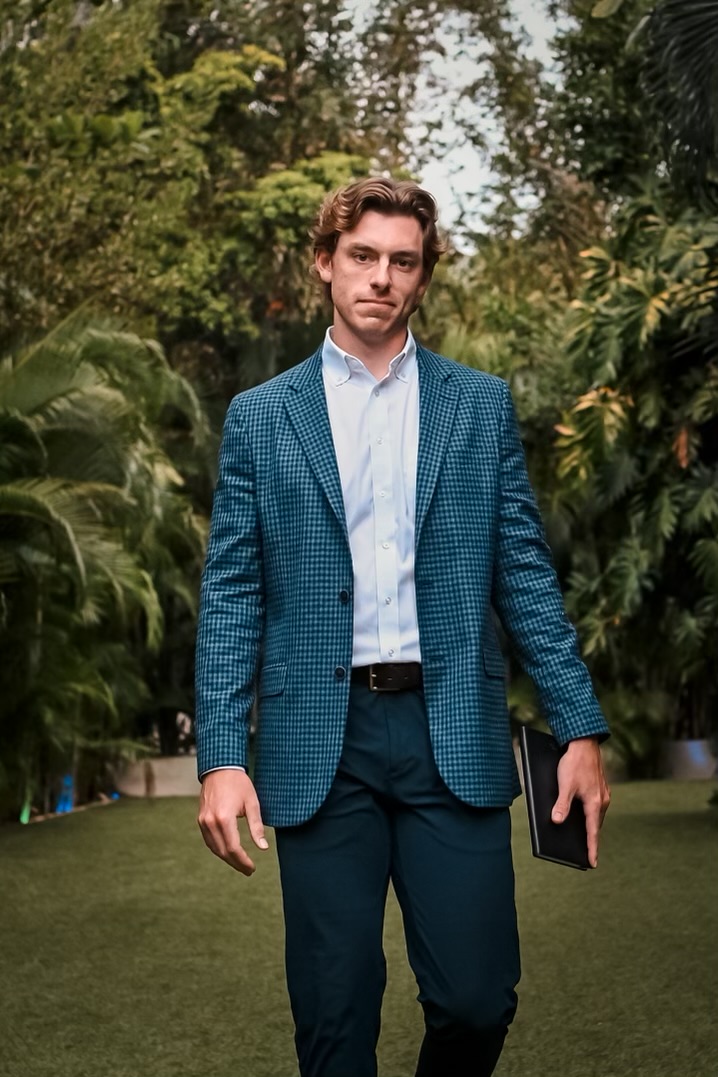
Today we’d like to introduce you to R.C. Bennett
Alright, so thank you so much for sharing your story and insight with our readers. To kick things off, can you tell us a bit about how you got started?
For a long time, probably since junior year of high school, I have kept a journal—not so much a daily chronicle of events, but a record of the sorts of ideas I am wrestling with at any given time. As I continued to write and read the writings of others over the years, I noticed something strange. I thought that after a deep analysis I would find that my anxiety was the result of an overactive imagination combined with an exaggeration of the problems at hand, but that isn’t what I found. I started to realize—and I suppose this could be wrong, but if it is, I’m not sure how it could be wrong—that the depth of the issues plaguing my psyche were simultaneously beyond my capacity to solve yet very much in need of solving.
Somewhere along the line, I began to notice that answers to these sorts of existential questions seemed to be hidden within narrative. Sometimes the emergence of these “moral” or “religious” answers seemed intentional, but that wasn’t always the case. With a piece of fiction like East of Eden, for example, the biblical messaging is explicit. Steinbeck parses out passages of scripture and then proceeds to map the meaning across his own narrative. It is still up to the reader to determine whether this sort of mapping holds weight or not, but he doesn’t leave any ambiguity as to his sourcing. Other times, the emergence of these more traditional archetypes appears to be completely unintentional, like the recent film, ‘Challengers,’ which is effectively a modern spin on ‘Beauty and the Beast’ despite the fact that I haven’t seen any reports claiming that to be the intent of the writers.
All of this fascinated me, and I knew I had some questions and ideas I wanted to wrestle with, so I wrote ‘some may roam’ as an opening salvo to my career as an author. The project has been incredibly fulfilling, and it was a relief to step away from the more toxic forms of communication that take place online and live within Crews’ narrative for a while. One thing that I learned while writing the story, and I hope that those who read the book see this as well, is that you can disagree with Crews and still root for him, or perhaps you can agree with him and still hold anger toward him. I don’t think he is entirely correct in all of his philosophical ramblings, but there is a sort of, as the Greeks called it, ‘logos,’ that makes his character real and true even if the things he says aren’t technically correct. And seeing that in a piece of art that I created was incredibly encouraging. I think that’s the sort of thing that changes the world. All of us are going to be wrong about things, and sometimes those mistakes have real consequences despite our lack of malicious intent. Yet in spite of all this, it seems to be the case that we can participate in some higher moral order—for lack of a better word for it and without a fully scientific understanding of it—that allows us to live together as a community and for communities to live within a larger society.
Can you talk to us a bit about the challenges and lessons you’ve learned along the way. Looking back would you say it’s been easy or smooth in retrospect?
In terms of the company, our primary struggle has been one of obscurity. Like anyone, I have a certain number of friends and family who have purchased the book out of support for me, and we have seen some orders come in as a result of our advertising efforts, but for the most part our target audience doesn’t know we exist yet. My wife, Casey, is much more artistic on the visual front than I am, so having her on the team has been instrumental in developing a social media presence. Being able to foster that, primarily on Instagram, is going to take time, but it will be a major driver of revenue over the years to come.
On the personal side, the difficulty has been in determining where to aim, professionally. I have a chemistry degree and have worked in business development within the construction industry since graduating from college, so becoming a novelist wasn’t exactly the next logical step. I have been all over the place to some extent trying to figure out what to do with my ideas and interests, but I think that is part of the journey when you’re young. I was blessed to receive a phenomenal education from the time I was in kindergarten and even though I don’t spend much time reading mass spectrometers anymore, the rigor of my college course load was critical to my ability to think critically about complicated ideas.
We’ve talked about it elsewhere in the interview, but the meaning and the fulfillment that I have found in writing stories has been a surprise to me. I’ve always been a lover of hearing good stories, but I did not think I would be trying to tell them professionally. I suppose the jury is still out on whether or not the stories I’ve written will resonate with people, but as it stands today, I am proud of ‘some may roam’ and I am excited about the next book that is in the works whether or not either of them ever receive mass recognition.
Alright, so let’s switch gears a bit and talk business. What should we know about your work?
Holding the belief of an audience is a fickle thing. You can introduce dragons and demons, flying cars and time travel, and readers will track with you without a moment’s hesitation, but there is some sort of reality that still transcends the narrative and if you aren’t true to that, whatever the hell that reality is, people will put the book down, or worse, they’ll believe the lie that you told them.
To the extent that the Grove Park product is distinct from the product other publishing companies are bringing to the market, I would imagine it has a lot to do with the fact that we don’t have market research. We don’t know what sells. All I have is my own personal experience, what I have been able to learn to this point, and an honest attempt to tell a story that’s true despite being a work of fiction. And to some extent at least, that has to be unique. No one else has the same perspective as me, and I think for people who grew up here in and around Memphis, it’s a treat to pick up a John Grisham book or flip on one of the movies they made based off his books and see Tom Cruise on the roof of the Peabody. Memphis is a special place with a unique sort of culture, so my hope is that I have done it justice.
Can you talk to us about how you think about risk?
There’s a quote from Alice in Wonderland of all places that has haunted me since I heard it for the first time, and it’s, “ ‘In my kingdom,’ as the Red Queen tells Alice in Wonderland, ‘you have to run as fast as you can just to stay in the same place.’ ”
I really can’t put my view on risk any clearer than that. You can mitigate particular “risks” but you can’t mitigate “risk” itself. Staying in the same place brings about risks of its own in an ever changing world, especially one that is far from perfect in its current state. So, I tend to shoot from the hip a little bit. Sometimes it goes well. The sharks I swam with didn’t bite me, but I think that’s because they were really more like big catfish than great whites. Other times it doesn’t go so well. My second day on the mountain in Lake Tahoe I had to get snowmobiled to safety following a rough crash and a concussion. I wrote and published my own novel without any formal background or training in writing or publishing. Not really sure if that one is going to end with a violent crash or smooth re-entry into the boat, so to speak, but I’m content to find out.
Call it fortunate or unfortunate, but I don’t see a way forward that excludes us, you reading and me writing, from the change we will see in the world. We may choose to remain silent, to remain, as Socrates put it, “unexamined.” We may value the preservation of our lives over examination. We may find our agency to create change greatly limited or even outright restricted. We may find the path forward to be more thorn-ridden than the stillness of our current position. We may find that the road that has carried us this far is incapable of taking us to where we want to be, but either way there’s no honor in sitting still.
Somehow, some way, you have to learn how to keep moving while understanding that the path you’re headed down might not be the right one. Once I realized that, to be honest with you, it scared the hell out of me. I thought that “humility” was this sort of meek trait that harmless people had, and then I read these old stories of wise heroes, and I realized that real humility is a sort of learned trait. It’s the ability to move and listen at the same time. I try to work that into my stories. I don’t assume that the “hero” knows everything at the beginning, nor do I assume that the “villain” is beyond saving. I realized that the “hero” doesn’t exist within the pages of a book or on a movie screen. It’s a sort of orientation that is on offer for anyone who’s willing to take it.
Contact Info:
- Website: https://grovepark.us
- Instagram: https://www.instagram.com/groveparkpublishing/
- Facebook: https://www.facebook.com/people/Grove-Park-Publishing/61566866124038/