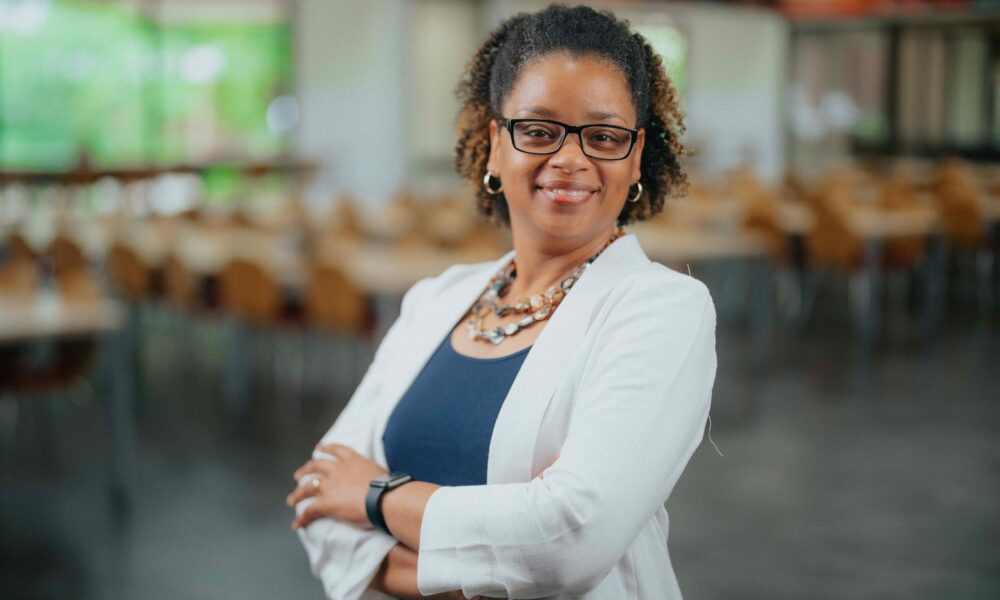
Today we’d like to introduce you to Tarvis Williams-Mull.
Hi Tarvis, can you start by introducing yourself? We’d love to learn more about how you got to where you are today.
By the time I was 20 years old, I was the mother of three children, having my first child at the age of 15. Even at this young age, I understood that the odds were not in my or my children’s favor, so I was determined to change the ending of our story.
My high school attendance was horrible, but my struggle was never the lack of academic knowledge. Honestly, I never felt like anyone cared if I was at school or not. I would miss weeks of school and no one – at home or school – ever questioned why I was not attending school or even encouraged me to go. I ended up dropping out and later earning a GED.
To support my children and myself, I worked odd jobs to supplement the government-provided assistance, but I had to be careful not to work too many hours or I would jeopardize the food and healthcare benefits which I could not afford on my own. Shortly after having my third child, I enrolled in an 18-month dental assisting program at the Tennessee College of Applied Technology – Memphis. I received a dental assisting diploma and later earned my state certification and registration. I worked as a dental assistant for ten years and I loved it!
Once the youngest of my three children started kindergarten, I enrolled at Southwest Tennessee Community College and was later able to transfer my credits to the University of Memphis from which I earned a bachelor’s degree in political science. I thought my vehicle for changing the world for single mothers and their children was politics, but I was introduced to another avenue by some unlikely new allies.
My children attended a neighborhood elementary school, and we received so much love (sometimes tough love), encouragement, and support from the principal and teachers. This was quite different from the experience I’d had with teachers and school. This school team was such an inspiration to us that my older daughters and I decided to take an educational career path – my oldest daughter began her career as a school social worker before starting her therapy practice, my middle daughter is a school psychologist, and I decided I wanted to become a teacher. I was accepted into an alternative route program, Memphis Teaching Fellows, and after six weeks of training, I was a high school special education teacher.
Fifteen years later, I am still an educator. I am also a wife, a mother of four, and a grandmother.
Can you talk to us a bit about the challenges and lessons you’ve learned along the way? Looking back would you say it’s been easy or smooth in retrospect?
Smooth? Absolutely not! But I wouldn’t change much of anything because I’m a firm believer that our lives – the good, bad, and ugly – are ours to live as a testimony for others.
My life before becoming a teenage, single mother wasn’t gumdrops and lollipops. I’d experienced some form of mental, physical, and emotional abuse and neglect throughout my childhood. By the time I was 18, I’d been homeless, hungry, and broken to my core. As I was pursuing educational and career opportunities, I had to depend a lot on other people who didn’t always want to help or who didn’t always come through on their promises. Because society had already determined the fate of people like me – a teenage dropout, a single mother from a housing project – I’ve had to spend a lot of time dispelling the myths that people have which cause them to make assumptions about my worth and abilities.
I experienced a lot of death early in my life, but mostly from a distance. When I did encounter death “up close,” the transitions were due to natural causes – except the death of my paternal grandfather who had been killed in a hit-and-run as he crossed a street. For about six years straight, it seemed that I couldn’t escape death. In 2015, my oldest sister died from a sudden heart attack, she was only 45. Exactly 13 months after the day we buried my sister, my only son was shot and killed in a road rage incident on March 28, 2016, he was only 22.
Nine months later, my oldest daughter’s father would also lose his life to gun violence. In 2020, my youngest nephew, who was only 16, was gunned down as he waited in a friend’s car at a gas station. In 2020, we also lost my father-in-law and in 2021, both my brother-in-law and sister-in-law died after complications from Covid-19. Amid all of this ‘up close’ death, I lost several childhood friends, and several of them also lost their children.
Early on, I couldn’t yet name the unseen power that continued to give me the strength, mercy, and courage to keep moving forward, but I always knew it was a power greater than me. As I kicked down one obstacle after the other, it became crystal clear to me that God is the unseen power who keeps me!
As you know, we’re big fans of you and your work. For our readers who might not be as familiar what can you tell them about what you do?
Since becoming an educator in 2008, I’ve served in numerous capacities but with one goal – holistic student growth and achievement. I believe to truly educate children and help them develop into constructive citizens, we must understand who they are individually and support them – emotionally, socially, and academically. Every child has the right to a ‘total education’ that addresses their needs and cultivates their dreams, no matter their zip code.
My first teaching assignment was in an urban high school, for which mostly all my family and friends thought I was crazy for accepting because of the reputation of the area it was in. Turns out, this assignment remains the most fulfilling one I’ve had yet! About 50% of the staff were young teachers, new to the profession and we were adamant about changing things for the students and the community that a lot of people had written off. We banned together to ensure our students were able to experience and enjoy the same opportunities that students at other high schools did.
As a special education teacher, I wanted our students with disabilities to understand that these opportunities were also open for them, so I advocated for them to receive new special education evaluations, to be able to participate in the school’s vocational-technical programs, and to take the ACT exam. As a result, many of my students graduated with a general education diploma, and several of them went on to explore post-secondary options – technical programs, college/universities, and the military. Every so often, I run into one of my former students who is a wielder and I joke with him that he’s making more money than me (it’s not a joke!).
After seeing the difference that could be made for students in a single school, I got the itch to see if it could be done on a wider scale. I was given the opportunity to support the special education program for five schools in a small district in the same community. The district’s leaders didn’t feel the district possessed the human or physical resources to support the needs of students with disabilities, so they had been externally placing students in schools in a larger neighboring district.
As the Director of Special Education, I worked to recruit the appropriate special education personnel and service providers and to ensure everyone understood the laws and policies that govern special education while also increasing their knowledge and skills on how to collaboratively educate students with disabilities. As a result, we built a comprehensive PK-8th grade special education program that granted our students with disabilities access to general resources while also providing them with an education appropriate for their individual needs. In doing so, we significantly decreased the number of students who were externally placed.
I’ve always been dually endorsed as a special and general educator in the State of Tennessee. Although I’d had about six years of success supporting content and content teachers, I had no experience as an actual content teacher. After taking some time off after my son’s death, I decided to reenter the education world as a content teacher. I applied to teach middle school social studies because I have a minor in history, but I was asked by the principal to teach science and to support RTI2-A as an interventionist. Of course, I had to learn the science content, but I was able to lean on my knowledge and experience as a special education teacher which proved extremely beneficial to all my students. The transition was not difficult, and I loved teaching science!
I enjoyed teaching so much that when I accepted the role as the Professional Learning Communities Coach (PLCC) at the school, I asked my principal if I could still teach at least one class… of course, the answer was no (lol!). Currently, I’m still serving as the PLCC at the same school in the Memphis Shelby County Schools (MSCS) district. As a PLCC in MSCS, my main responsibility is collaborating with leaders, teachers, support staff, and parents to develop and execute annual school improvement plans to support student achievement.
I never stop thinking about how I can expand my reach to support more students, more teachers, more families, and more communities. I recently completed the MSCS Aspiring Leaders Fellowship program because my next short-term professional goal is to become an assistant principal.
If we knew you growing up, how would we have described you?
When I was very young, one of my aunts nicknamed me “Ms. Hathaway” after The Beverly Hillbillies character Jane Hathaway because she thought I shared some of the same characteristics – a matter-of-fact, business-like, and plain.
She was definitely on to something; it was clear that I was quite different from my siblings and cousins. I was the traditional middle child, mostly invisible to my older siblings and viewed as overbearing by my younger siblings. This led to me spending a lot of time alone, which I was very comfortable doing.
I loved reading, playing make-believe, pretending to be a teacher to my dolls, and playing dress-up to perform some of my favorite songs.
Contact Info: