
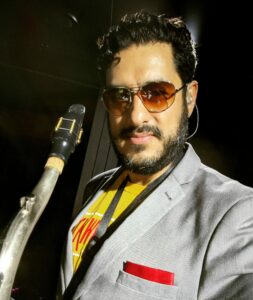
Today we’d like to introduce you to David Baron Stevens.
Hi David Baron, we’re thrilled to have a chance to learn your story today. So, before we get into specifics, maybe you can briefly walk us through how you got to where you are today?
In 2018, I was invited to come to Memphis and join the B.B. King Blues Club All-Stars as a saxophonist. This new job would change my life and I haven’t looked back since. My career in music, however, started long before this.
I was born in Los Angeles, CA in 1980 to an immigrant mother from El Salvador, and a Romani (also known as “Gypsy”) father from New York. Soon I found myself being raised by my mother alone and we were moved to Central California’s San Joaquin Valley by her new husband. It was a major culture shock for me, going from freeways and movie stars to living in a town where the cows outnumbered the population of the city.
During all this time, I was enduring some serious challenges that no child should ever face. Life was hard for everyone in this town, from poverty to extreme drug abuse and one of the highest teen-pregnancy rates in the United States. For me, the added challenges of being completely different, with no real connection to family or long-time friends, made life unbearable as a young person. I wanted my life over before it began. Mental health was a major factor for me, even as a young person.
When I was introduced to band class in 5th Grade (age 12), and offered a variety of instruments to choose from, I immediately chose the saxophone. This instrument was a dream of mine since I first heard Steely Dan’s song “Deacon Blues”, about someone who wishes to learn the sax and live the life of a touring musician, with the ups and downs that come along for the ride. Even at that young age, I knew this was my destiny.
At first, I was very discouraged because my mother told me we couldn’t afford to rent a saxophone. I would either have to play the trombone or nothing at all. I chose nothing at all. Only when a family friend offered to let me play their daughter’s saxophone, long gone unused, was I able to avail myself of the chance to study music and focus on anything other than the life I despised.
I quickly annoyed family and neighbors with my incessant practice, often up to 3 hours per day at age 12. Soon, their annoyance turned into anticipation. I’d find neighbors sitting outside with their families to listen when I would practice.
At age 14, my uncle, a professional trumpeter in Los Angeles, told me that in order to become a professional musician, I would need to practice 6 hours a day, if I was to get paid like any other “8 to 5” job. So I did just that. I wrote up a schedule, hour by hour, minute by minute, of how I could do 6 total hours of practice each day during my next summer break.
At age 16, I was offered my first professional job as a saxophonist, and have pursued this career since. What I didn’t know at the time, was that I was a “sole-proprietor” business entity and would soon need to learn all about the business side of the “music business.” I also began teaching through private music lessons, and have also been in this business since.
That same year, I graduated early from high school through the California High School Proficiency Exam and registered for a community college in Fullerton, California, well-known for it’s music program. Those plans were cut short by a near-death car collision in May 1996, in which I broke my pelvis in 6 places, my collarbone, and my skull. The latter led to full paralysis of the left hemisphere of my face and left me unable to play the saxophone. My efforts and dreams to escape my circumstances through my talent and hard work were now shattered, like my body.
Over the next few months, I endured extreme pain and mental anguish until the point at which I regained my ability to play. Though my facial muscles never returned to full strength, sensation, and control, from permanent nerve damage, I managed to get enough back so that it’s not very visible and that I can at least perform the sax (and other woodwinds) with just a bit extra effort.
Rather than head to Los Angeles (Fullerton) as planned, I had to recover at home and returned to my high school for band classes only, for the social aspect of school. Only 2 months after regaining my ability to play, I sent in an audition and was selected as the 1st chair in the state of California for the 1998 High School All-Star Jazz Band, in competition with hundreds of other teenagers from cities such as Los Angeles and San Francisco. The biggest trial of my life was now officially overcome.
Since then I have achieved many national and international awards and achievements, studied with some of the world’s most prolific and excellent masters, accepted by some of the world’s most prestigious universities and conservatories, and taught some of today’s most successful artists.
Little did I know all those years ago that I was what would be referred to as an “entrepreneur.” I never considered myself as “self-employed”, even though I had to do my own bookkeeping, communicate with clients, advertise, set policies (and at times enforce them), and that if I wanted to be successful as a performer and teacher, regardless of my talent, my business acumen must be as excellent. Most independent artists are not aware of this fact. To this day, I preach to all of my young brothers and sisters in the arts, that they MUST come to this realization and pursue what is necessary to have a successful business in the arts, not merely be good at their talent.
I endured many hardships due to my ignorance on these matters. My degree was earned at the “School of Hard Knocks”, and the lessons I’ve learnt came from the pain of not wanting to repeat such an experience. I’ve since learnt the value of being able to read, write, and negotiate contracts. Accounting can be the difference between a “side-job” and a “career”. The best business in the world without marketing is the ‘tree that falls in the forest that no one hears.’ Most of all, I’ve learnt the difference between ‘making music’ and being in the “business of making music.”
This brings me back to why Memphis has given me a new home for my business. I currently work in multiple continents and time zones, with family in the UK. I want my business to be incorporated in the USA. California is not the most encouraging place for small business. Since spending more and more time in Memphis, I’ve found what I believe is the best home for my world headquarters. I love how the locals are working toward building up the community. I see the efforts in Soulsville to offer services ‘as you can pay.’ This is not unlike my approach with my teaching studio, in which I’ve often found alternate arrangements for students that are struggling financially.
I recall one student, in particular, that when his family lost a significant amount of income, rather than discontinue lessons, I had him wash my car after each lesson as payment, until the family income improved. Soon, his young sister was able to take lessons with me as well, and both have gone on to excel in music.
I believe in the old saying “a rising tide raises all ships.” I believe that profit should never come before service. No business starts off “in the black,” or making a profit. All new businesses suffer losses for the first few years. This should be seen as an investment into the long-term goals of the business, not as an indicator of success. Success for entrepreneurs is measured in longevity. Before the crash of 2008, I’d reached my cap of 20 students with 5 consistently on the waiting list, achieved without advertising in 3 years. Through creativity in marketing and by setting my goals in line with my circumstances, I was able to maintain a solid income in the music business for a decade, before age 30.
I believe this is the sort of approach that will benefit the varied communities in Memphis. I’ve had a great time there, performing on and off Beale Street, meeting local musicians and businesses, and seeing the great opportunities provided students and locals through Stax and Memphis Slim House. I want to be a part of that and bring my expertise and experiences to the town that has given me, and the world, so much.
My 5 year goal has me with a music school in Soulsville as close to Stax as possible, and a recording studio on Main Street. Both entities will provide professional services, with the “pay as you can” model as an option for locals, and particularly students. I’ve never turned someone away for lack of ability to pay, and intend to uphold that principle. A free lesson or recording session won’t break me, but it could be the difference for a kid who could either be running the streets or sitting in a room working hard to impress their teachers.
Would you say it’s been a smooth road, and if not what are some of the biggest challenges you’ve faced along the way?
My biggest challenge in business has been ignorance.
For a very long time I never even realized I was self-employed until I started filing taxes business taxes. There was no one in my schools teaching me about business entities, contracts, accounting, marketing, etc. All of my focus was on the quality of my product and my skills to deliver. For a very long time I didn’t realize that the $100 I received for a job was to be split toward my gasoline, rent, supplies, food, car insurance, etc.
I really wish I’d learned these business skills right along with my training in music. I believe the two go hand in hand, particularly for those seeking the arts as full-time employment.
I also have experienced many disappointments due to not knowing who to trust and not being precise regarding contracts. Learning business law is what will prevent you from being burnt by unscrupulous individuals, which we all come across at times. One of my masters, Yamaha Flute Artist Tracy Harris, once told me, “no one who refuses to sign a contract has any intention of fulfilling the agreement.” That lesson is recalled to my mind in EVERY negotiation I’ve made since and to this day.
Another difficult challenge has been with mental health. Every artist who spends hours and hours a day locked in a room training will attest to how that affects their mental state, ability to connect and socialize with others, and how relationships often suffer as a result. It’s very difficult for artists to succeed in business when their mental health is not in check, regardless of their skills. I consider this one of the most important aspects of life and business, equal to or more so than even physical health. Not enough young artists consider this as essential, and struggle to maintain as a result.
As you know, we’re big fans of you and your work. For our readers who might not be as familiar what can you tell them about what you do?
Above all else, I consider myself an “American Musician and Educator.”
I started with jazz, playing along with my mother’s CDs until I could imitate every note on the recordings, dreaming to be on stage with my heroes. My career has seen many of those dreams fulfilled, such as the night in 2005 in which I performed with Eric Marienthal, one of my all-time favorite saxophonists.
Growing up, I was obsessed with jazz and studied it incessantly like a martial art. I joined bands full of “white-hairs”, or older musicians, who accepted me and taught me so much of what I know today. By age 16, I was wearing tuxedos and performing at Gala events. Jazz led me to commercial music, which is often a way jazz musicians make a living.
Growing up as a teenager in the 1990s, I was also exposed to and loved hip hop, with artists like Dr Dre and Wutang, and later Erykah Badu and D’Angelo, making such an influence on me that these artists fill my set lists even today when I perform live.
One of the things that sets me apart, and which I’ve used to my advantage, is my heritage as a Gypsy (Romani). Our people are known for assimilating easily wherever we are. I pick up languages and accents quickly. We are the definition of “multi-cultural” and my music expresses this. Every one of my original compositions reflects a genre from a different region of the world, all aspects of my own personality.
I’m no longer just a jazz musician. Latin Jazz, Salsa, Reggae, Ska, Hip Hop, Funk, R&B, Soul, Blues, Bluegrass, Metal, Classic Rock, are all the types of music I adore and produce regularly. This is why I refer to myself as an “American Musician”, since these varied genres all, as a composite, tell the story of America, and what we have given to the world. In this way, as a 1st Generation child of America, I feel proud to represent our people when abroad.
As an educator, I’ve been privileged to have worked with some tremendously talented young artists, many of which are quite successful in today’s market. The experience of not being able to afford private lessons growing up motivated me to provide that service to those in financial need. I’ve never turned away a student who worked hard for me, but I regularly discontinued lessons with paying clients that did not maintain the standards I’d set for them. Money has never been my motivation, only to pass on what I’ve learnt to the next generation. I will never be a baby sitter. I’m here to train and prepare the next generation for successful careers. The money comes when you are good at your job and when everyone is benefiting from it.
I started teaching at age 16 as a side job, driving all over the region to give lessons at their homes. Soon, I found music stores in which I could teach and stay central, thus saving money in travel and time, and making more profit. Later, I became connected with the local college and began teaching there as well. The area’s top instructors would all send me their best students after reaching a certain level, for me to take them further. My standards of excellence and the hard work required to achieve those goals were the focus of my teaching, and I’m so proud of what my students have achieved.
My method of teaching is unorthodox. I do not focus on how much time is spent in practice. I prefer to focus on the regularity of practice. I expect daily practice, regardless of if it’s one minute per day or one hour. I often liken musical training to exercise and strength training. Results come from regularity, even if a workout is light today and heavy tomorrow. A musician that practices only one thing each day will find themselves 365 times more proficient in a year.
This method has been greatly influenced by the Shaolin martial arts monks of China. I break down each movement associated with the production of sound, down to its most fundamental motion, and focus on that, repeatedly, for hours, for months. Mastery of a little bit will always be better than mediocrity at many things.
Too often, music is taught through the eyes. I prefer to let the ears be the true educator. Regardless of the genre, whether jazz or classical, all of my students learn from the recordings of masters. Reading sheet music is a valuable skill, even essential in some jobs. However, ONLY being able to read, without having heard it, will make someone sound like a deaf person trying to speak. I will take a blind musician any day over a deaf one.
What matters most to you?
The most important things to me are honesty, kindness, and empathy.
I try to employ these principles in every action I make, in or out of business. Pure honesty allows the other party to be well-informed enough to decide for themselves whether or not to make a move with me. Anything less that pure honesty would be robbing that person of the ability to decide and could put them, and the entire deal, in jeopardy. The consequences of dishonesty are much more serious than simply a bunk deal.
Imagine buying a car that you didn’t know there was a brake problem. Everything in the car looks good. It drives well. But the seller didn’t tell you that there’s a brake fluid leak, and that within weeks, the brakes could go out if not checked out. You could take the car to a mechanic and have that fixed easily, and no one gets hurt. But because the seller didn’t want to lose the sale because of this or was just greedy and wanted to avoid discounting it over this, you and those with you, are at risk of death.
Had the seller just been honest and willing to accept a bit less money, everyone would be happy. You would get a cheaper price, and maybe you have a good mechanic which will do the repair at low cost. You get your car, they get their money, and everyone is safe and satisfied. The other scenario benefits only one at the risk of everyone else.
Honesty, and the lack of it, has real consequences, in and out of business. Be straight up with everyone and let them decide what to do. If someone doesn’t trust you even when you’re honest, that says more about them than it does about you. In fact, you don’t want to do business with someone who is offended by honesty.
Sometimes honesty can be harsh. Even the best truths can be delivered in a way that is unkind, and therefore, rejected. Regardless of how valuable something is that you have to say, if you don’t treat people kindly, they won’t accept a single thing you offer. In today’s world, everyone is being abused by their employers and families. A little bit of kindness goes a long way.
Be kind, until you cannot. Then, just walk away.
Empathy is essential if we are to achieve the other 2 goals. Until you can literally “feel what someone else is feeling”, or “walk in their shoes”, we can never truly understand how to treat people. Never forget that everyone we meet, everywhere in the world and in every language, has someone at home they care about, is trying to make a living, and has unfulfilled dreams. It doesn’t matter what we have today. We could be that person tomorrow.
Never discount the person with nothing. Maybe they just lost their corporate job due to “reorganization” or maybe they were someone’s uncle whose wife left them and took him to court where he couldn’t afford the lawyer and lost his kids and home, then his job. Or maybe that person is a millionaire and dresses in shorts and t-shirt. The first time I met the late Tommy Peters, former CEO of Beale Street Blues Company (B.B. King Blues Club), that’s exactly how he looked. We don’t know where people come from and all we can do is understand that at some point in our lives we COULD be that person.
It’s easy to be kind to someone we might have been or might become down the line.
Pricing:
- Sax Stage Performance: $100/hr
- Jazz Theory and Saxophone Lessons: $60/hr
- Arranging & Transcription: $3/measure/part
- Saxophone Recording Performance (remote): $50/hour
- Private Music Lessons (for financial hardship): Pay as you can
Contact Info:
- Email: davidbaronstevensmusic@gmail.com
- Website: www.davidbaronstevens.com
- Instagram: https://www.instagram.com/davidbaronstevens
- Facebook: https://www.facebook.com/davidbaronstevens
- Twitter: https://twitter.com/davidbstevens
- Youtube: https://www.youtube.com/c/DavidBaronStevensPersonal
- SoundCloud: https://soundcloud.com/david-baron-stevens


 Image Credits
Pictured: Albert King, Jr